The tender for the first private housing Government Land Sale (GLS) site in the highly anticipated Bayshore precinct marked a defining moment for Singapore’s residential property landscape. Closing on March 18, the tender drew eight competitive bids, underscoring strong developer confidence in Bayshore’s long-term potential despite a cautious global macroeconomic environment.
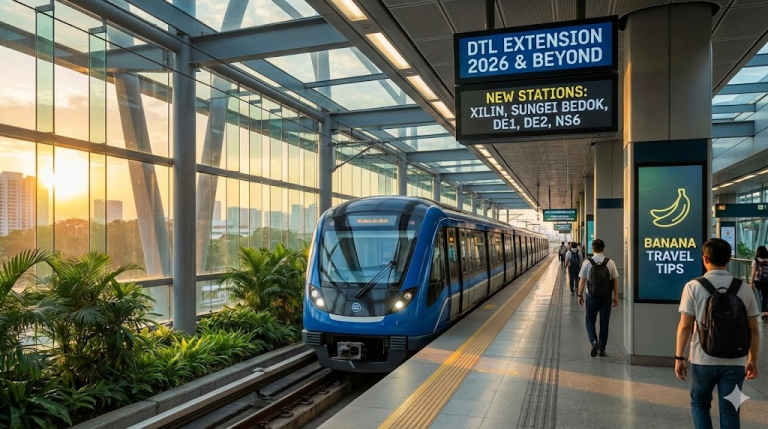
The 99-year leasehold site, strategically located along Bayshore Road and directly adjacent to Bayshore MRT Station on the Thomson–East Coast Line, spans approximately 112,992 square feet and is estimated to yield around 515 residential units. As the first private residential plot to be released in the new Bayshore estate, the site is widely regarded as the precinct’s flagship parcel—setting both pricing expectations and market sentiment for future launches.
SingHaiyi Emerges Top Bidder with Record OCR Land Rate
The top bid of $658.89 million, translating to a land rate of $1,388 per square foot per plot ratio (psf ppr), was submitted by SingHaiyi-Garnet, a joint venture between SingHaiyi Group and Haiyi Holdings, an entity controlled by Celine and Gordon Tang, which also holds a majority stake in SingHaiyi.
The winning bid stood out not just for its quantum, but for what it represents: a new benchmark for Outside Central Region (OCR) land prices. SingHaiyi’s offer was narrowly ahead—by just 0.82%—of the second-highest bid of $653.53 million ($1,377 psf ppr) submitted by Sing Holdings. The tight margin between the top two bids highlights how closely developers valued this site, reflecting shared conviction about its prime attributes.
City Developments placed third with a bid of $620.8 million ($1,308 psf ppr), roughly 5.3% lower than Sing Holdings’ offer. Commenting on the outcome, Justin Quek, CEO of OrangeTee & Tie, observed that the highest bid exceeded initial market expectations, suggesting robust confidence in the site’s future prospects despite prevailing market uncertainties.
Highest Bid Count Since Jalan Tembusu GLS in 2022
Market watchers were quick to note the significance of the eight-bid turnout. According to Mark Yip, CEO of Huttons Asia, this marks the highest number of bids for a private housing GLS site since January 2022, when the Jalan Tembusu plot—now developed as Tembusu Grand—also attracted eight bidders.
Yip noted that developers may have deliberately held back from other GLS tenders in recent months to focus resources on the Bayshore site, which is widely viewed as a rare opportunity. Strong primary market sales in recent quarters have also intensified the need for developers to replenish their land banks, particularly with sites that offer clear differentiation and long-term appeal.
Wide Bid Spread Reflects Divergent Risk Appetites
Beyond the top contenders, the tender drew bids from a diverse mix of developers, including a Frasers Property-led consortium, Kingsford Development, and a joint venture between Hoi Hup Realty and Sunway Developments. These bids ranged between $1,252 psf ppr and $1,285 psf ppr, still reflecting strong interest but with more conservative pricing assumptions.
At the lower end of the spectrum, the two lowest bids highlighted contrasting market sentiments. A consortium comprising Hong Leong Holdings, TID, and CSC Land Group submitted a bid of $500.68 million ($1,055 psf ppr), while Sim Lian Group placed the lowest bid at $485 million ($1,022 psf ppr).
The 36% gap between the highest and lowest bids illustrates how differently developers assessed the balance between risk and reward for the Bayshore site. Marcus Chu, CEO of ERA Singapore, commented that such a wide spread reflects mixed sentiment amid a still-evolving market backdrop—but also reinforces how exceptional sites tend to polarise bidding strategies.
A New OCR Benchmark That Rivals Central Region Land Prices
SingHaiyi’s winning bid of $1,388 psf ppr decisively resets the OCR land price benchmark, surpassing the previous high of $1,250 psf ppr paid in November 2023 by MCL Land and CSC Land Group for the Clementi Avenue 1 site, now launched as Elta.
Wong Siew Ying, Head of Research and Content at PropNex, pointed out that the new OCR benchmark is now comparable to land rates in the Central Region. In 2024 alone, GLS sites such as Zion Road Parcels A and B in the Rest of Central Region were awarded at $1,202 psf ppr and $1,304 psf ppr, while Core Central Region sites like Holland Drive and River Valley Green (Parcel A) achieved $1,285 psf ppr and $1,325 psf ppr, respectively.
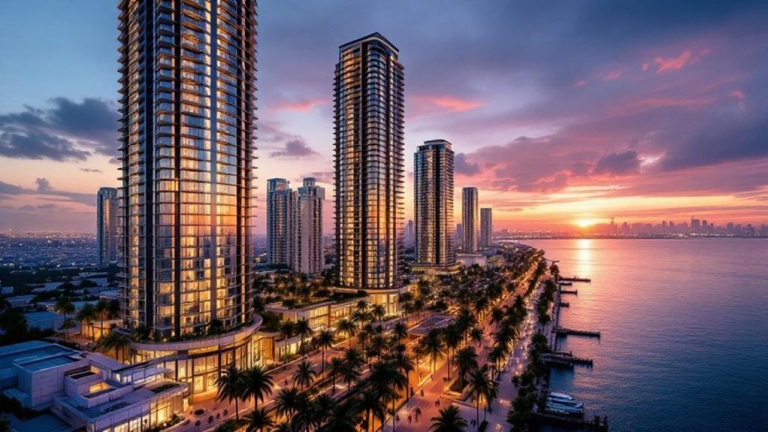
That an OCR site could command land rates within striking distance of these central locations speaks volumes about Bayshore’s perceived transformation from a quiet coastal stretch into a future-forward waterfront district.
Bayshore: A 60-Hectare Waterfront Vision Takes Shape
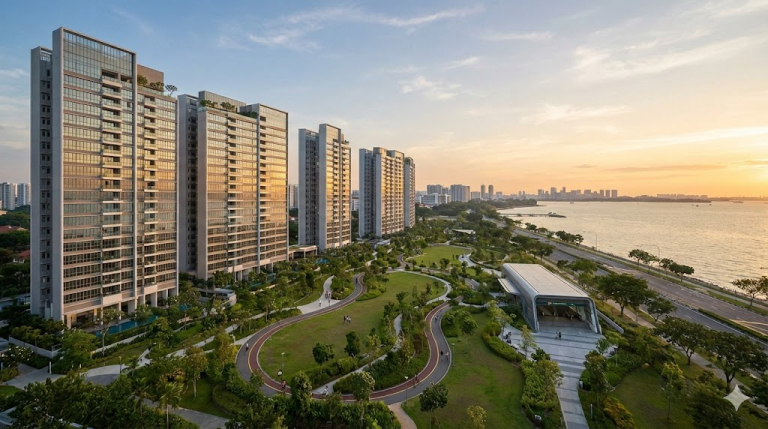
The future development at the Bayshore Road GLS site will be the first private residential project within the new Bayshore precinct, a 60-hectare master-planned estate nestled between East Coast Parkway (ECP) and Upper East Coast Road. The precinct is slated to accommodate approximately 10,000 homes, of which around 30% will be private housing, with the remainder comprising public housing and supporting amenities.
This balanced planning approach is expected to foster a vibrant, mixed residential community while preserving the precinct’s coastal character. Importantly, the first private project is widely seen as setting the tone—both in pricing and positioning—for all future private developments in Bayshore.
Why This Particular Site Stands Out
According to Huttons’ Yip, the Bayshore Road GLS site is “probably the best site in the Bayshore precinct,” citing its potential sea views and doorstep access to Bayshore MRT Station. Such attributes are exceptionally rare in Singapore’s private housing market, particularly outside the Core Central Region.
Beyond immediate conveniences, the area stands to benefit from long-term national infrastructure initiatives. Leonard Tay, Head of Research at Knight Frank Singapore, highlighted the significance of the Long Island coastal protection project, which will introduce new reservoirs, parks, and reclaimed land along the East Coast. These enhancements are expected to reshape the coastline while providing flood resilience, recreational spaces, and long-term environmental sustainability.
Pent-Up Demand After Decades Without New Private Launches
One of the most compelling aspects of the Bayshore story is the sheer lack of recent private condominium launches in the area. Wong noted that existing developments nearby—such as The Bayshore (launched in the 1990s) and Costa Del Sol (launched in 2000)—are now decades old.
This prolonged supply gap has likely created pent-up demand, particularly among HDB upgraders from nearby Marine Parade and Bedok estates, as well as buyers seeking newer homes along the East Coast. With improving market sentiment and strong recent sales momentum in the primary market, it is unsurprising that developers competed aggressively for the opportunity to secure a first-mover advantage in Bayshore.
Pricing Expectations: A New Reference Point for the East Coast
Taking into account the winning land rate of $1,388 psf ppr, Wong estimates that the future Bayshore project could achieve average selling prices above $2,600 psf. Tay of Knight Frank offers an even more bullish view, suggesting that prices could start from around $2,700 psf and average above $2,800 psf, reflecting the site’s unique attributes and long-term growth narrative.
If realised, such pricing would firmly reposition Bayshore among Singapore’s premium coastal residential addresses—bridging the gap between traditional OCR developments and city-fringe waterfront living.
A Defining Moment for Bayshore’s Future
Taken together, the outcome of the Bayshore Road GLS tender represents far more than a successful land sale. It marks the beginning of a new chapter for Singapore’s eastern waterfront—one defined by thoughtful planning, strong connectivity, and long-term vision.
As the first private residential development in the precinct, the future Bayshore project carries symbolic and practical significance. It will not only shape buyer expectations and pricing benchmarks, but also serve as a litmus test for how Singaporeans respond to a reimagined East Coast lifestyle—one that blends MRT convenience, coastal living, and future-ready infrastructure.
In that sense, the strong response from developers may be less about short-term market cycles and more about a shared belief: Bayshore is finally setting sail.